iPad Mini 8 (OLED) vs iPhone Duo: Which Should You Buy?
This is the new iPad mini. It's thinner than an iPhone Air, it's the lightest iPad Apple has ever made, and it finally has an OLED screen. It also starts at $699, which is $200 more than the mini I've been using for the last five years. This is hands-down my favorite iPad: it's tiny, the screen's big enough, and since I mostly use an iPad to watch stuff, it's the one that comes with me when I travel.
Most reviews will compare it to the 2024 iPad mini (7th gen), but I don't think that's who's upgrading. People keep iPads for five years or more. I've had my iPad mini 6 since 2021. I use it pretty much every morning on the treadmill, and after five years it has slowed down and the battery is hanging on for its life. So I'm answering two questions: Is this worth it coming from a 6th gen? And should you get an iPhone 18 Pro plus an iPad mini instead of an iPhone Duo? That second one came up a lot on my iPhone Duo review, and it comes down to one thing, which is absolutely not the price.
Quick Verdict
- Coming from an iPad mini 6? Absolutely upgrade. You get OLED, no more jelly scrolling, much better battery life, Apple Intelligence, a front camera that's actually centered on calls, IP67 water resistance, and a much thinner, lighter body. This is the upgrade 6th-gen owners have been waiting five years for.
- Have the 2024 mini? I'd probably wait, unless OLED was the one thing you wanted.
- iPhone 18 Pro + iPad mini vs iPhone Duo? On paper, the combo wins: it's cheaper, you get the best phone, and you get the bigger screen. But the Duo is always in your pocket. It really comes down to how organized you are.
The big letdown is that it's still 60Hz. It's the most expensive iPad mini Apple has ever made, but it's still my favorite iPad.
Price: The Painful Part
| US | Canada | |
|---|---|---|
| iPad mini 6 (2021) at launch | $499 | $649 |
| iPad mini 7 (2024) at launch | $499 | — |
| iPad mini 7 after June 2026 increase | $599 | — |
| iPad mini 8 (OLED) | $699 | $949 |
In June 2026, Apple raised the 2024 mini to $599 because memory prices have gone through the roof; pretty much every company is raising prices because of AI. The new one starts at $699, and here in Canada it's $949, up $300 from the 6th gen's $649.
The weird part is that the 11-inch iPad Air is only $50 more at every storage tier and still has an LCD, which makes this the cheapest OLED iPad you can buy. With prices like this, though, a lot of people are going to hang on to their iPads even longer.
Design: The iPhone Air of iPads
The idea hasn't changed; it's a small iPad, just pushed a little further.
| iPad mini 6 | iPad mini 8 (OLED) | |
|---|---|---|
| Screen | 8.3" LCD | 8.5" OLED |
| Thickness | — | 5.4mm (thinner than the iPhone Air) |
| Weight (Wi-Fi) | 293g | 255g |
| USB-C | 5Gbps | 10Gbps |
| Peak brightness | 500 nits | 1,200 nits (HDR) |
| Refresh rate | 60Hz | 60Hz |
| Water resistance | None | IP67 |
| Battery (my test) | 7 hours | 11 hours |
The bezels are 24% thinner, so the bigger screen fits in a body that's pretty much the same size as my old one, but it's so much thinner. Next to my 6th gen, it honestly feels like I'm holding the iPhone Air of iPads. At 255g for the Wi-Fi model, it's lighter too; that's just 1g heavier than the iPhone Duo.
Everything else will feel familiar. Touch ID is still in the top button (put your finger on it and you're in), and the buttons are in the same spots. There's no SIM tray anymore, because the cellular models are now eSIM only. The USB-C port is 10Gbps, versus 5Gbps on the 6th gen, so copying files is twice as fast.
The front camera finally moved
The change I care about most is the front camera, which is now on the long edge. On a FaceTime or Zoom call in landscape, I'm actually centered instead of looking off to the side like on the 6th gen. Both have Center Stage, so they follow you around. The mics on the new one sound better too. The 6th gen picks up a lot more noise, while the A20 Pro uses AI to clean up your voice as you're talking.
Display: Finally OLED (but Still 60Hz)
The biggest upgrade is the screen. It's OLED, something we've been asking for on the mini for years, and it's gorgeous. It hits 1,200 nits peak brightness in HDR, more than twice the 6th gen's 500. It's not the tandem OLED from the iPad Pro, but HDR really pops, and next to my old LCD mini it's night and day.
Reading is the other big win. In a dark room, the only pixels that light up are the words, while on the old one the whole backlight has to come on just to show you white text. It also dims all the way down to 1 nit, so it's not blasting you in a dark room.
The bad news is that it's still 60Hz, and I can't stand 60Hz. I scroll a lot, and when everything else in my house or on me is 120Hz or higher, I notice it right away. Even the base iPhone 17 has 120Hz. The good news is that the jelly scrolling from the 6th gen is completely gone. If you don't remember, when you scrolled in portrait, one side of the screen lagged behind the other, so text looked like it was tilting. On this one, everything moves together.
vs the iPhone Duo's inner screen
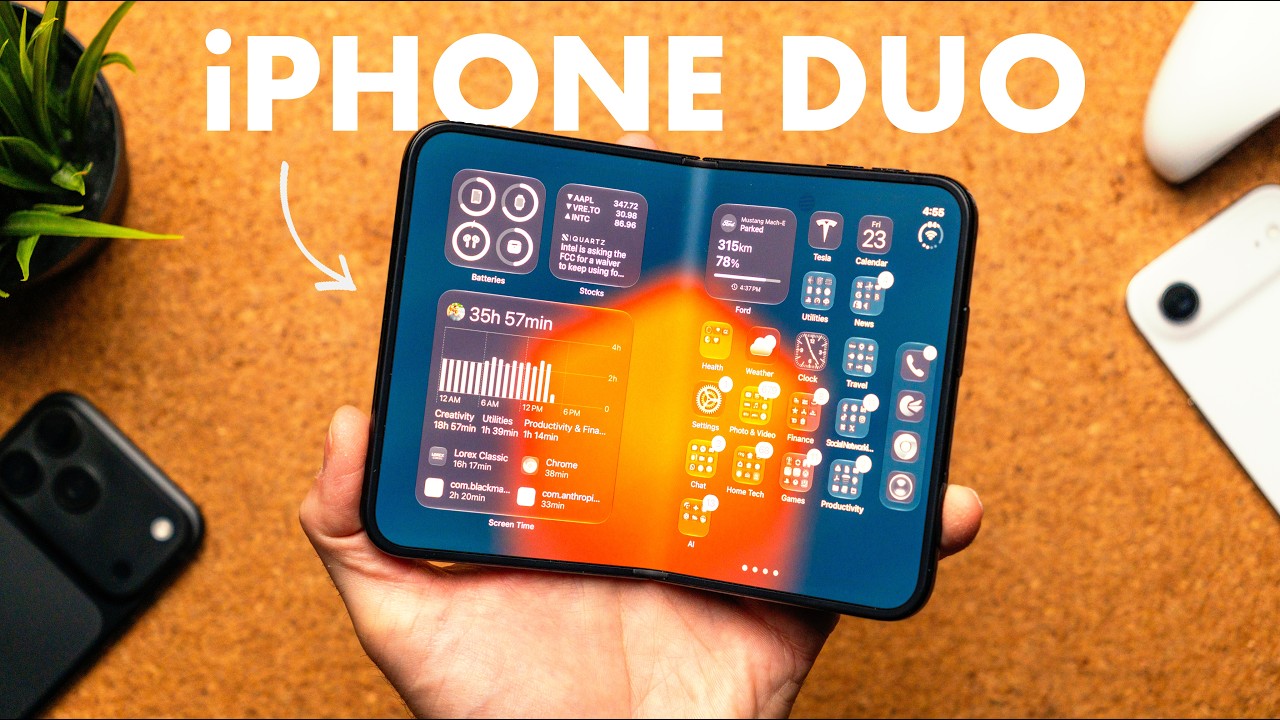
The Duo's inner screen is 7.6 inches and this is 8.5. That doesn't sound like much, but side by side it's a big difference: about 20% more screen. And because the mini is a wider shape, a regular YouTube video plays about 30% bigger. For watching stuff at arm's length, this size is the sweet spot. To be fair, the Duo's screen gets brighter and it's 120Hz. The mini's advantage is strictly size, but sometimes size does matter.
Apple Pencil
The 60Hz shows up with the Pencil too. Going back and forth between the Duo and the mini, writing on the Duo felt smoother. Part of that is the 120Hz, and part of it is the Duo's inner screen: it's a softer plastic with nano-texture, so it feels more like paper. The mini's standard glass is a harder surface; it's still smooth, the Duo just felt more natural. But writing on a flat surface is much better on the mini, because it lies flat on the table, while the Duo wobbles like crazy.
If you want that paper feel on the mini, you can get nano-texture glass, but only on 256GB and up, and it's another $100.
The mini works with two pencils, the Apple Pencil Pro and the USB-C Apple Pencil. The Duo only works with the USB-C one. So if you want one pencil for both, it has to be the USB-C Pencil, which pairs with a cable, so every time you switch devices you have to plug it in again.
Speakers and Water Resistance
The speakers were redesigned too, and there are no speaker holes anymore. Apple calls it an acoustic display: the tweeters are hidden in the gap between the glass and the aluminum frame, and the woofers play through the display itself. So instead of two regular speakers, it's now a two-way system with tweeters and woofers. It's not a massive jump, but it does sound better.
Sealing up the speakers is also how Apple got water resistance. This is the first iPad with an official water-resistance rating: IP67, so if it falls in the pool it should survive up to 1 meter deep for 30 minutes. It's water resistant, not waterproof, and Apple's warranty doesn't cover water damage. But if your kids are using it on vacation, accidents happen, and it's one less thing to worry about.
Performance
After five years, my 6th gen has slowed down: apps take longer, and the battery has degraded. The new A20 Pro is an absolute monster. It's the same chip that's in the iPhone 18 Pro and the iPhone Duo.
- Geekbench single-core: over 4,000. My M5 iPad Pro got 3,600, so in single-core the iPad mini actually beats the iPad Pro. The M5 still wins multi-core by almost 50%, because it's an M-series chip with more cores. Against the iPhones with the same chip, it's basically a tie.
- vs my iPad mini 6: single-core is more than 2× faster, and multi-core is almost 2.5×.
- 3DMark Steel Nomad: almost 3,000, more than double my M3 iPad Air and only about 5% behind the M5 iPad Pro.
A quick test doesn't show what happens when it heats up, so I ran the 3DMark Wild Life Extreme stress test, the same graphics test 20 times in a row over about 20 minutes. On the first run, the mini even beat the M5 iPad Pro. Then it heats up and settles at about 70% of that, while the iPad Pro held 92%, so for long gaming sessions the Pro still wins.
What I didn't expect: even at its slowest, the mini was faster than the iPhone Duo at its best. Same chip, very different results. Once they're both heated up, it's about 2.7× faster than my 6th gen. Honestly, I never once wished it were faster. I mostly watch stuff and play games on a mini, and nothing I've played needed more.
RAM and Apple Intelligence
The RAM is the bigger deal for 6th-gen owners. The 6th gen can't run Apple Intelligence at all, so no new Siri AI. This one can, since it has 12GB, and I can run a 4-billion-parameter AI model right on the iPad, offline, to summarize a document or do simple tasks with no internet. On the 6th gen, it won't even load.
Battery and Charging
Battery is where I noticed the biggest difference. This one idles really well: I can leave it for a couple of days and it has only used a few percent. Apple claims up to 10 hours of web or video, and in my test I actually got 11 hours. My 6th gen got 7. To be fair, the 6th gen was also rated for 10 hours when it was new, so a lot of that gap is battery age, but the more efficient chip and the OLED definitely help.
Fast charging gets you 50% in 30 minutes, but you need a 35W or bigger charger, and the one in the box is only 20W, so that's another charger to buy if you want faster charging. The 6th gen tops out around 20W, with no fast charging at all.
Software: Real iPad Windowing
The other big reason to get an iPad over the Duo is the software. On the Duo you get two apps side by side, but they're still basically iPhone apps. On the mini you get real iPad windowing: open a bunch of windows, resize them, and flip between them. With iPadOS 27.2, you can plug it into a monitor, add a keyboard and mouse, and get an extended display, like a little desktop.
iPhone 18 Pro + iPad mini vs iPhone Duo
| iPhone 18 Pro + iPad mini 8 | iPhone Duo | |
|---|---|---|
| US price | $1,898 | $1,999 (with a long wait) |
| Canada price | ~$2,700 | ~$3,000 |
On paper, the combo wins. It's about $100 less in the US and about $300 less in Canada, and you get the best phone and the bigger screen, while the Duo is a bit of a compromise on both.
But here's the thing: the Duo is always in your pocket. With an 18 Pro and a mini, I have to decide in the morning whether I'm bringing the iPad. With the Duo I never have to think about it; the big screen is just there. So it really comes down to how organized you are.
Personally, I use the mini as a companion to whatever smartphone I'm carrying, including the Duo. When I know I want the bigger screen, like on a flight or on the treadmill, I bring the mini. The rest of the time, the Duo has me covered.
Buying Tip: Skip the 512GB Unless You Need the Storage
Every storage tier gets the same 7-core GPU. The 512GB model is the only one with the full chip: a 6-core CPU instead of 5 and a dual Neural Engine. Single-core is the same, so day to day you won't feel the difference. (Mine is the 512GB model, so my multi-core numbers will be a bit higher than on the 128GB or 256GB tiers.) I wouldn't spend $999 just for one more core; get the 512GB only if you need the storage.
The Bottom Line
Is this an upgrade from the 6th gen? Absolutely. You get OLED, no more jelly scrolling, much better battery life, Apple Intelligence, a front camera that's actually centered on calls, a body that can survive a dip in the pool, and one that's much thinner and lighter to carry around. If you have the 2024 mini, I'd probably wait unless OLED was the one thing you wanted. It's the most expensive iPad mini Apple has ever made, but it's still my favorite iPad.
Want the full breakdown on the Duo? Read my iPhone Duo review or watch the video on YouTube.
Where to Buy
- iPhone Duo — Check it out here
Affiliate Disclosure: This article contains affiliate links. If you purchase through these links, we may earn a commission at no extra cost to you.
Published: November 2026